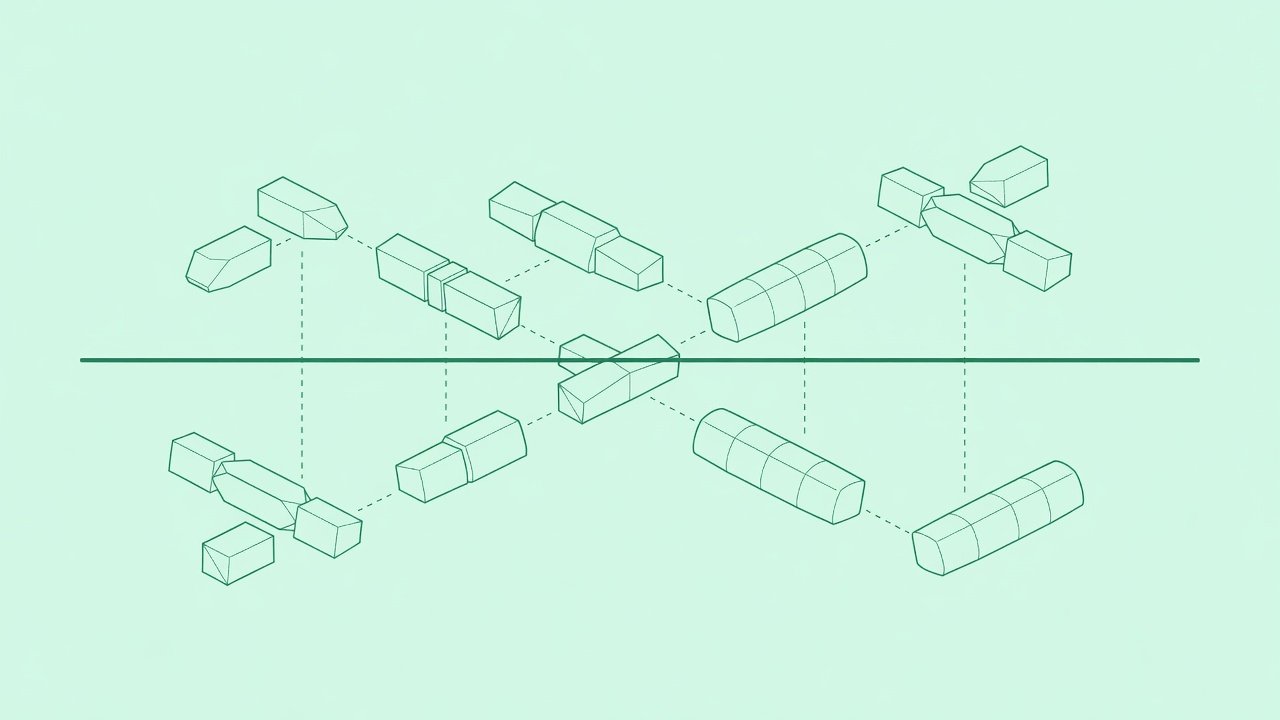
Begin with the route to the room
An orbital habitat must fit a transport architecture before it can become a place to live. Launch loads, packaging, deployment and connection influence the interior long before furniture is considered. A proposed room cannot be evaluated only at its final illustrated size. Ask what travels inside it, what is installed later and which operations must occur before an inhabitant can safely use it.
The International Space Station provides a major precedent for incremental assembly, but its development history is not a simple commercial business model. A new project may choose a different launch sequence or a more integrated initial configuration. Either way, construction decisions create lasting operational consequences, including where cargo enters and how people move between essential functions.
Understand what a rigid module offers
A rigid pressure shell can support extensive integration and inspection on the ground. Equipment may be installed before launch, subject to the transport and mission design. That can make some interfaces easier to test as part of a larger assembly. However, the usable interior is constrained by the chosen structure, packaging and installed systems; an external diameter is not the same as accessible living space.
Thales Alenia Space has experience with pressurised space infrastructure, including elements associated with the International Space Station. Such heritage helps establish a technical context, but it does not automatically qualify a new design. Each project still needs its own structural, environmental and safety evidence. Familiar shapes should not be mistaken for completed certification.
Evaluate expansion beyond the headline volume
Expandable structures seek to separate a compact launch configuration from a larger deployed envelope. The Bigelow Expandable Activity Module, known as BEAM, provides flight experience relevant to that approach. Sierra Space’s LIFE habitat work provides another public reference for examining expandable concepts and testing. Neither reference means that every proposed expandable room has equivalent maturity or intended use.
A domestic review should ask how the expanded space is outfitted. Where do racks, partitions, restraints and service lines come from? What must the crew install, inspect or verify after deployment? Additional enclosed volume can be valuable, but habitability depends on usable geometry, environmental systems and an achievable commissioning process, not volume alone.
| Route | Design opportunity | Issue to examine |
|---|---|---|
| Rigid module | Ground integration within a fixed envelope | Launch packaging and usable internal clearance |
| Expandable module | Different launch and deployed configurations | Deployment, inspection and interior outfitting |
| Combined architecture | Different structures for different functions | Interface complexity and service continuity |
Treat the connection as inhabited space
A hatch is more than a circle between attractive rooms. It is a transfer route for people, cargo and emergency response. Nearby handholds, lighting, labels and stowage can determine whether the connection is convenient or persistently obstructed. A proposal should be walked through with realistic cargo handling, not only an unencumbered figure moving through an empty opening.
Connections also carry or coordinate structural loads, power, data and environmental services according to the chosen architecture. The International Docking System Standard is a useful reference when examining docking interfaces, but it is not a universal interior-planning manual. Docking and berthing are not interchangeable labels; their operational differences need to be understood within the specific mission design.
Separate arrival from readiness
A module reaching orbit is an important event, but it does not by itself establish that the interior is ready for routine occupation. Commissioning can involve checks of pressure integrity, environmental performance, power, communications and integrated behaviour. The exact process belongs to the operator and responsible technical authorities. Public discussion should avoid compressing those stages into a single triumphant image.
Concepts such as Orbital Reef and Starlab are useful subjects for comparing announced architectures and intended markets. Gateway offers a different context associated with lunar exploration rather than a direct template for a commercial low-Earth-orbit workplace. These distinctions matter: mission duration, logistics and emergency assumptions cannot be transferred casually from one setting to another.
Leave room for change and eventual departure
A habitat may need new payloads, replacement equipment or additional accommodation. Expansion should therefore be considered alongside the circulation and service network. Adding a module can change travel distances, shift noise relationships and place new demands on shared systems. A connection reserved for growth has little practical value if the existing equipment cannot support the intended addition.
End-of-life planning belongs in the same conversation. Responsible design considers how operations conclude, how occupants depart and how the orbital asset is managed afterward. No interior concept resolves those obligations on its own. Return to everyday living and ask whether the construction strategy produces a coherent home, then review the systems that keep that home usable.