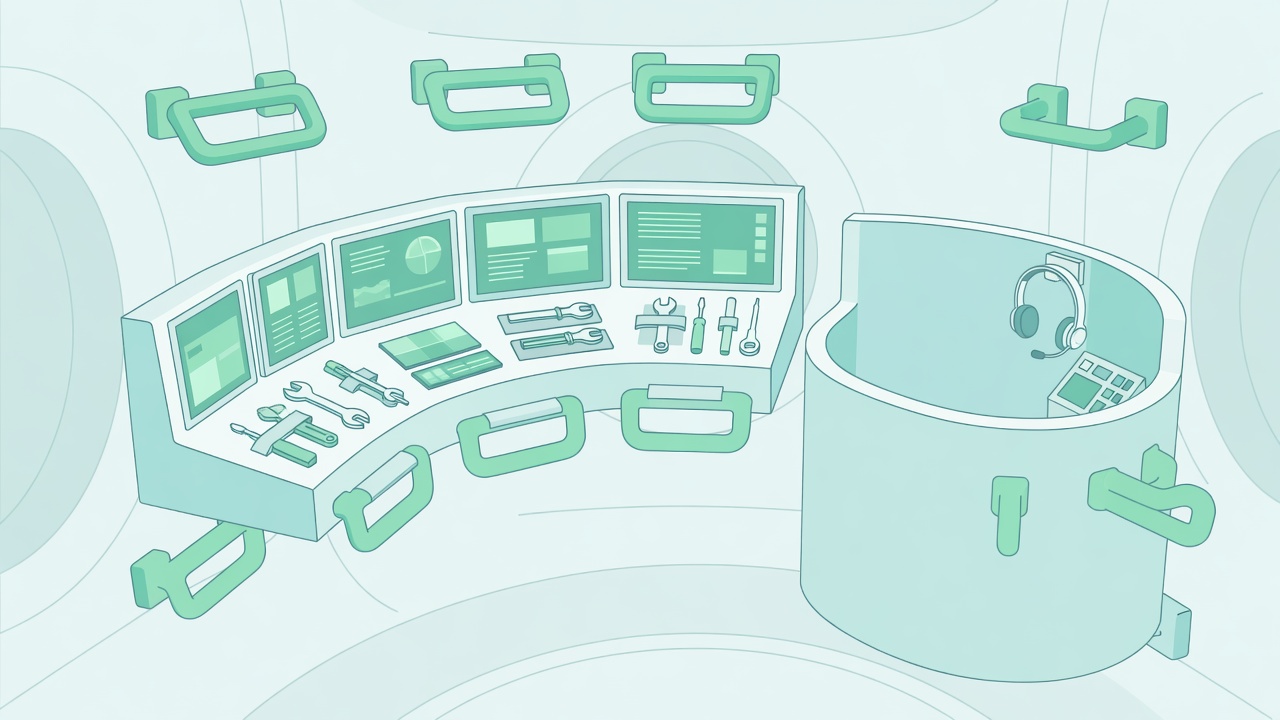
Describe the work before drawing the desk
“Working in space” can mean operating an experiment, preparing a sample, inspecting a system or joining a planning call. Those tasks require different equipment, postures and levels of separation. A generic laptop floating beside a window tells us very little about whether a workplace will function. Begin with a task sequence, including preparation, cleanup, documentation and the transfer of responsibility to another person.
The Columbus laboratory of the European Space Agency and the Kibo laboratory of the Japan Aerospace Exploration Agency offer concrete reference points for research accommodation. Their arrangements reflect specific interfaces and operational requirements. They are useful precedents for asking how experiments connect to resources, not evidence that every commercial habitat should resemble an existing laboratory.
Stabilise the person, not only the equipment
In microgravity, applying force to a tool also affects the person using it. Body restraint, handholds and the location of contact surfaces therefore belong in the earliest layout studies. A workstation should support a useful range of body sizes and allow the user to reposition without releasing essential items. Retaining a tablet is not enough if the operator must constantly brace against an unrelated panel.
Design reviews should include gloves where relevant, awkward access and the moment when a second person assists. Loose cables can become both an obstruction and a source of repeated irritation. Equipment labels need to remain readable from the intended approach direction. The absence of a conventional floor does not eliminate orientation; it makes consistent local cues especially valuable.
Give concentration a place in the plan
Fans, pumps, conversations and alarms compete for attention. An open layout may simplify access but make focused analytical work difficult. Conversely, a sealed-looking booth may introduce ventilation and emergency-access complications. The design problem is not to choose openness or enclosure as a visual style, but to decide which tasks require protection and how that protection can be delivered safely.
A short private call can be important for medical, personal or commercial reasons. That does not justify placing a call area where it blocks a route to critical equipment. Scheduling helps, but only when it reflects the real overlap of activities. A facility hosting researchers and non-specialist visitors must also consider how informal conversation affects people conducting delicate or time-sensitive work.
| Activity | Spatial priority | Question to test |
|---|---|---|
| Focused analysis | Low distraction and usable displays | Can nearby maintenance continue without interrupting attention? |
| Hands-on experiment | Restraint, containment and access | Where does each tool go between steps? |
| Remote discussion | Speech privacy and stable communication | Can confidential information be overheard? |
| Equipment service | Clear working envelope and isolation | Can a component be removed without dismantling another task area? |
Budget time for the work around the work
A habitat’s productive capacity cannot be read from the number of experiment positions alone. Inhabitants also unpack cargo, find supplies, inspect equipment and return the workplace to a safe state. A layout that saves launch volume but adds repeated handling may consume valuable crew time. Storage should follow use patterns rather than fill whatever gaps remain after the attractive spaces have been drawn.
Ground support is part of this workplace. NASA and the Canadian Space Agency provide examples of organisations whose station activities involve extensive coordination beyond the crewed volume. A commercial operator will likewise need defined responsibilities, communication procedures and support arrangements. A beautiful room cannot compensate for an unclear handover or a maintenance instruction that does not match installed equipment.
Separate neighbouring activities intelligently
Research may impose requirements for vibration, cleanliness, thermal stability or containment. Exercise equipment, cargo handling and social activity can conflict with those needs. Separation does not always require a distant module; operational scheduling, dedicated mounting and appropriate containment may contribute. The correct combination depends on the experiment and must be evaluated technically rather than inferred from a rendering.
Commercial station concepts associated with Axiom Space and Starlab illustrate the variety of proposed users and programmes. Their public materials are useful for examining stated ambitions, but advertised accommodation should not be treated as demonstrated operational performance. When comparing proposals, ask what has flown, what has been tested on the ground and what remains a planned capability.
Protect the end of the working day
When people live beside their equipment, work can expand into every available hour. Clear shutdown routines, places to leave an unfinished task safely and a distinct route back to shared domestic space can help establish boundaries. Those choices matter for safety as well as comfort: fatigue and persistent interruption can undermine careful work.
A good workplace review ends by asking whether the next person can understand its state. Are tools retained, records accessible and hazards identified? Follow that question into maintainable environmental systems, or return to the domestic spaces that make recovery possible. The habitat succeeds only when work and rest can coexist.